
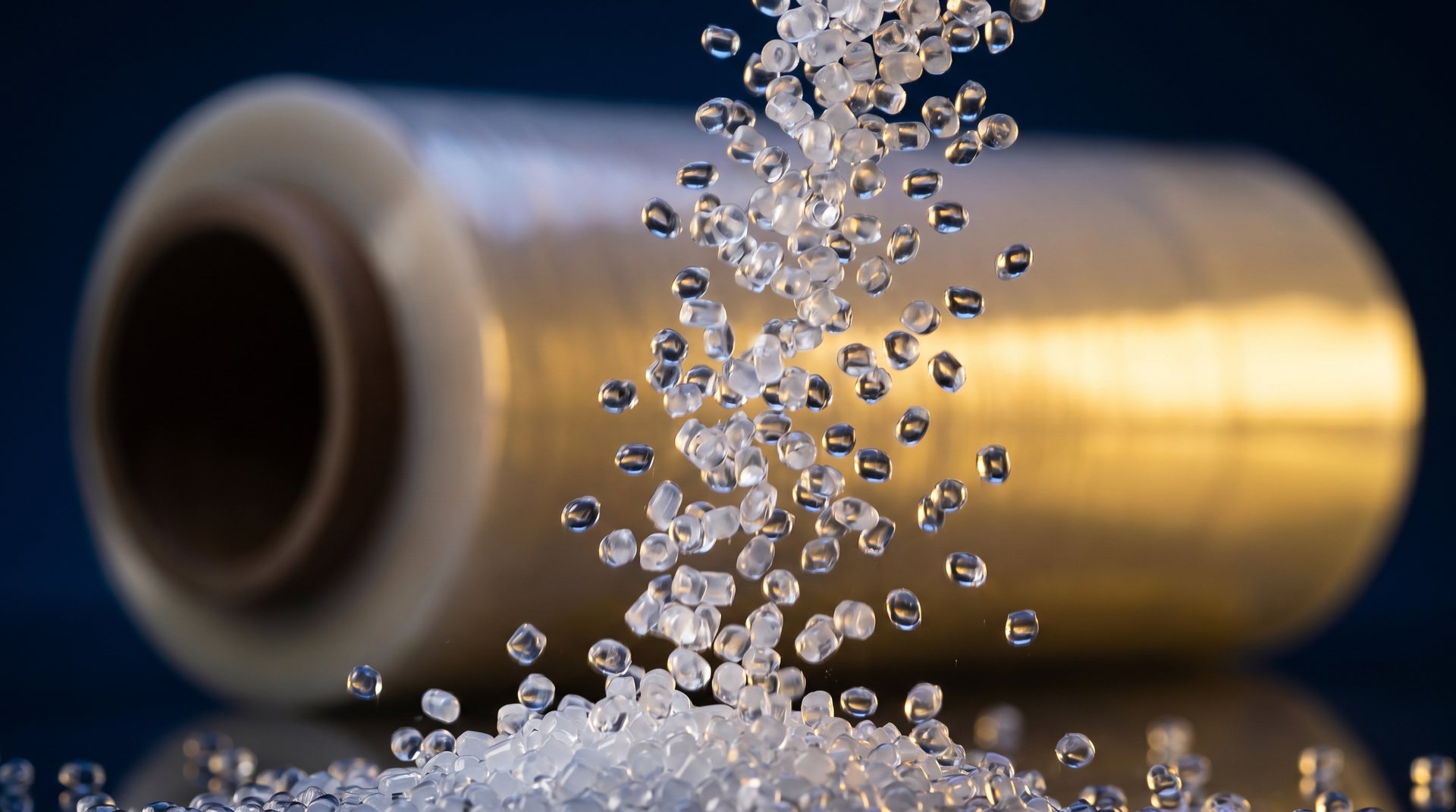
High-density polyethylene is the workhorse of the polymer trade — the resin behind pipe, film, crates, drums, bottles and countless industrial parts. It is also a market where buying the wrong grade is expensive: a pipe compound will not blow a bottle, and a fluid injection grade will tear as film. This guide, published August 13, 2026, sets out how experienced buyers specify, vet and receive HDPE — and why disciplined sourcing matters more than usual in the current freight environment.
Why timing matters now
Packaging polymer prices have turned higher again in August 2026 as renewed pressure on the Strait of Hormuz tightens regional supply, with ChemAnalyst noting HDPE trading roughly 40% above pre-crisis levels and quarterly blow-moulding import bands into India holding around the low-US$1,000s per tonne. S&P Global Commodity Insights has likewise reported US spot blow-moulding HDPE at its highest in about 13 months. In a firming, supply-constrained market, specification discipline and early ordering protect both budget and production continuity.
Step 1 — Match the grade to your converting process
HDPE grades are differentiated chiefly by density (typically 0.941–0.965 g/cm³) and melt flow index (MFI), which together determine stiffness, toughness and processability. Start from the process, not the price list.
| Grade family | Typical MFI (190 °C/2.16 kg) | Common applications | What to watch |
|---|---|---|---|
| Film (HMW) | <0.3 (often quoted as HLMI) | Carrier bags, liners, thin-gauge packaging | Melt strength, gel count, dart impact |
| Blow moulding | 0.2–2.5 | Bottles, jerrycans, drums, IBCs | ESCR, food-contact compliance where needed |
| Injection moulding | 4–20 | Crates, caps, pails, houseware | Flow/stiffness balance, warpage |
| Pipe (PE80/PE100) | Low; classified by MRS rating | Pressure pipe, gas and water networks | Certified compound (not natural + masterbatch), hydrostatic test data |
| Raffia / monofilament | ~0.7–1.2 | Woven sacks, ropes, nets | Draw-down behaviour, additive package |
If your application touches food, potable water or medical use, name the compliance requirement (e.g. FDA, EU 10/2011, drinking-water approvals) in the enquiry itself — it narrows the grade list immediately and avoids costly substitutions later.
Step 2 — Specify precisely, then verify the datasheet
- Name the exact grade, not just "HDPE". Producers publish grade slates with defined density, MFI, additive package and application approvals. Your purchase order should reference the producer grade name or an agreed equivalent list.
- Fix the acceptance window. Agree tolerances on density and MFI (for example ±0.002 g/cm³ and ±15% on MFI) and state the test methods — ISO 1183/1133 or ASTM D1505/D1238 — so a dispute is measurable.
- State form and packing. Pellets in 25 kg bags on shrink-wrapped pallets, or bulk bags for large converters; confirm bag weight, palletisation and container lining to prevent contamination.
- Require batch traceability. Each lot number on the packing list must match the Certificate of Analysis, so any off-spec material can be isolated without quarantining the whole shipment.
Step 3 — Vet the supply chain, not just the price
The Middle East is the world's largest polyethylene exporter — International Trader Publications puts the region's 2025 shipments at 18.7 million tonnes, around 43% of global PE exports — so most internationally traded HDPE has Gulf origins, and routing risk is now part of the buying decision. The same ITP analysis notes that Iranian export volumes have halted and that Red Sea diversions via the Cape of Good Hope have sharply raised container costs. New capacity is coming — Qatar's Ras Laffan complex added roughly 1.7 million tonnes of annual HDPE output in 2026 — but it reaches buyers through the same constrained shipping lanes. Practical checks: confirm the producer and country of origin on documents (not just the trader's word), ask how the parcel is routed and what the realistic door-to-door lead time is, and qualify a second origin for critical grades. Arian Holding's sourcing network spans Gulf, Asian and CIS producers across its trading sectors, which is precisely what makes multi-origin cover workable when one lane tightens.
Step 4 — Inspect and test on arrival
Even prime material deserves incoming checks: verify bag count and lot numbers against documents, look for moisture, dust or cross-contamination in the container, and run a quick MFI and density check on a composite sample before the parcel enters silo storage. For pressure-pipe compounds, insist on the producer's certification for the specific compound — a natural resin plus black masterbatch is not a certified PE100. A structured quality-assurance protocol at receipt is the cheapest insurance a converter can buy.
Step 5 — Plan logistics and cover deliberately
In 2026 conditions, seasoned buyers are ordering earlier and holding two to four weeks of additional safety stock on critical grades rather than buying hand-to-mouth. Understand your Incoterms exposure (who carries the freight risk between FOB and CIF/CFR), confirm insurance covers rerouting, and consolidate orders where possible to improve container economics. Coordinated trade logistics — booking, documentation, tracking and contingency routing — is where a trading partner earns its margin in a disrupted market. HDPE feedstock economics also track the wider petrochemical complex, so watching naphtha and ethane trends gives early warning of price direction.
The market backdrop in brief
Directionally, HDPE has firmed through the northern summer of 2026: blow moulding remains the largest processing segment by revenue share this year according to Mordor Intelligence, demand from packaging and infrastructure is steady, and supply-side risk — not demand — is the main driver of price strength. Buyers should treat current offers as time-sensitive and validate them against at least two origins before committing.
Working with Arian Holding
Arian Holding trades prime HDPE, LDPE, PP, PVC and PET from established producers, alongside the wider polymers portfolio, with in-house specification review, document control and multi-origin routing. Request a quote with your grade, volume and destination, and our trade desk will respond with firm, current offers and realistic lead times.
Frequently asked questions
What is the difference between HDPE film, blow moulding, injection and pipe grades?
The families differ mainly in melt flow index (MFI) and molecular weight distribution. Film grades run at low MFI (roughly 0.03–0.3 g/10 min under HLMI conditions) for melt strength; blow moulding grades sit around 0.2–2.5 g/10 min; injection grades are more fluid, typically 4–20 g/10 min; and pressure-pipe grades (PE80/PE100) are classified by long-term hydrostatic strength rather than MFI alone. A grade optimised for one process generally performs poorly in another, so always match the grade to the converting process first.
Which documents should I require with every HDPE shipment?
At minimum: a batch-specific Certificate of Analysis showing density, MFI and ash content against the datasheet; the technical datasheet for the exact grade name; food-contact or potable-water compliance statements where the application needs them (e.g. FDA or EU 10/2011 for packaging, relevant drinking-water approvals for pipe); and clean packing lists with lot traceability so off-spec bags can be isolated.
Is off-grade or wide-spec HDPE worth buying?
It can be, for non-critical applications — off-grade parcels typically trade at a discount to prime material. The risks are wider property variation between bags, limited or no CoA support, and no recourse on performance. It is generally unsuitable for pressure pipe, food contact or thin-gauge film. If you buy off-grade, buy from a trader who discloses the origin lot and test results, and trial the parcel before committing a full production run.
How are 2026 freight disruptions affecting HDPE buyers?
Renewed pressure on the Strait of Hormuz and continued Red Sea diversions have lengthened lead times and lifted delivered costs from Middle East producers, who account for the largest share of global polyethylene exports. Buyers are responding by ordering earlier, building two to four weeks of extra cover on critical grades, and qualifying at least one alternative origin so a single routing problem does not stop production.
Sources: ChemAnalyst (August 2026 packaging polymer pricing); S&P Global Commodity Insights (US HDPE blow-moulding spot); International Trader Publications (Middle East PE export volumes and disruption); Mordor Intelligence (HDPE market structure and Ras Laffan capacity). Market levels are indicative ranges around August 13, 2026. This guide is general information for procurement teams, not trading, investment or engineering advice; verify specifications against your own application requirements.