
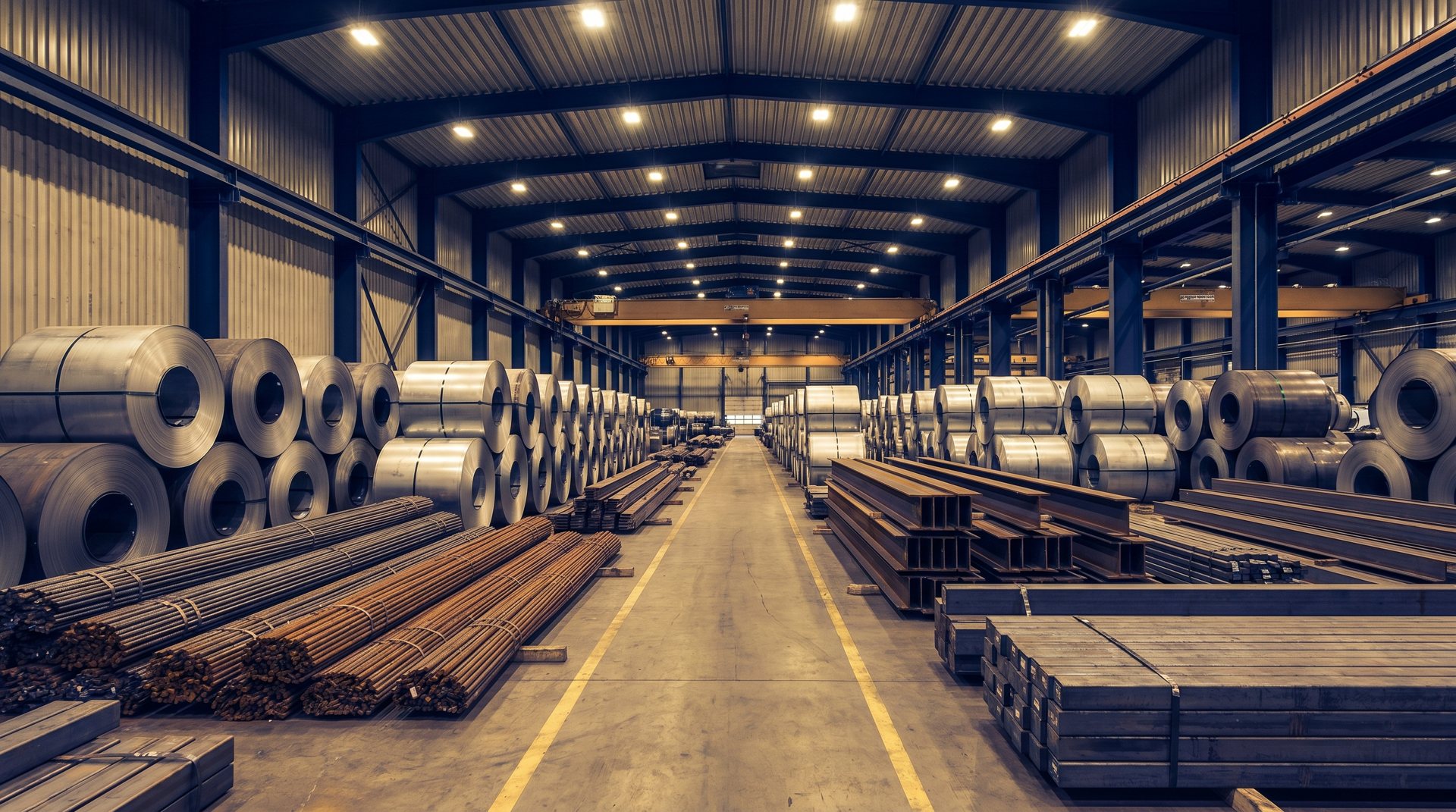
The defining feature of the complex this week is a split between what a cargo costs and what it costs to move. Underlying demand for ferrous and construction materials is soft, and mill-gate and terminal offers reflect that. Landed costs, however, are being pushed the other way by the disruption in the Strait of Hormuz and the surcharge stack now riding on every Gulf-bound container. Buyers who benchmark on FOB alone are reading only half the market. Each section below links through to the relevant product catalogue page for grades, specifications and quotations.
Today at a glance
| Commodity group | Direction | Read | Catalogue |
|---|---|---|---|
| Steel & iron ore | Softer | Turkish rebar easing in the mid-US$500s/t FOB; Chinese rebar futures at multi-month lows | Steel Products |
| Copper | Off highs | Well below January's record; still historically elevated on structural tightness | Non-Ferrous |
| Aluminium & zinc | Steady-firm | Both holding in the low-to-mid US$3,000s/t range on spot indications | Non-Ferrous |
| Industrial minerals | Stable | Barite, gypsum, clinker and aggregates tracking steady infrastructure demand | Minerals |
| Petrochemicals | Firmer | Urea has turned higher off the July base; methanol range-bound with a wide East–West spread | Petrochemicals |
| Polymers (PE/PP/PVC) | Upward bias | Packaging grades supported by Gulf supply disruption; PVC offers softer into South Asia | Polymers |
| Freight & logistics | Sharply higher | Asia–Gulf all-in rates up materially month-on-month; surcharges now a majority of the bill | Logistics |
Steel & iron ore
Long products remain the weakest leg of the complex. Turkish rebar was assessed in a US$565–585 per tonne FOB band at the start of August, drifting a few dollars lower on the week, according to the Arab Iron and Steel Union's price archive. In China, rebar futures slipped to around CNY 3,000 per tonne — the lowest since mid-2025 — with Trading Economics putting the benchmark steel price down roughly 2% over the month and around 6% year-on-year. Widening losses at Chinese mills and a soft construction pipeline continue to cap any rally attempt, while iron ore eased at the start of the month even as billet quotations firmed in several regional markets.
For project buyers this is a constructive window on the material itself, provided the delivered cost is modelled properly. Certified rebar, sections, plate and coil specifications are set out on our Steel Products page, with slab, billet and bloom options under Semi-Finished Steel — both part of the Industrial Products & Commodities sector.
Copper & non-ferrous
Non-ferrous has come off the boil without breaking down. Copper set an all-time LME cash high near US$13,270 per tonne in January; by early August the market had retraced substantially, with COMEX copper indicated around US$6.63 per pound. Spot indications tracking the LME benchmarks put aluminium near US$3,221 per tonne and zinc near US$3,672 per tonne. The structural story — grid build-out, electrification and data-centre demand against constrained mine supply — is intact, so we would treat the pullback as a re-entry window rather than a trend change for cathode, billet, ingot and wire rod programmes. Specifications are listed on our Non-Ferrous Metals catalogue.
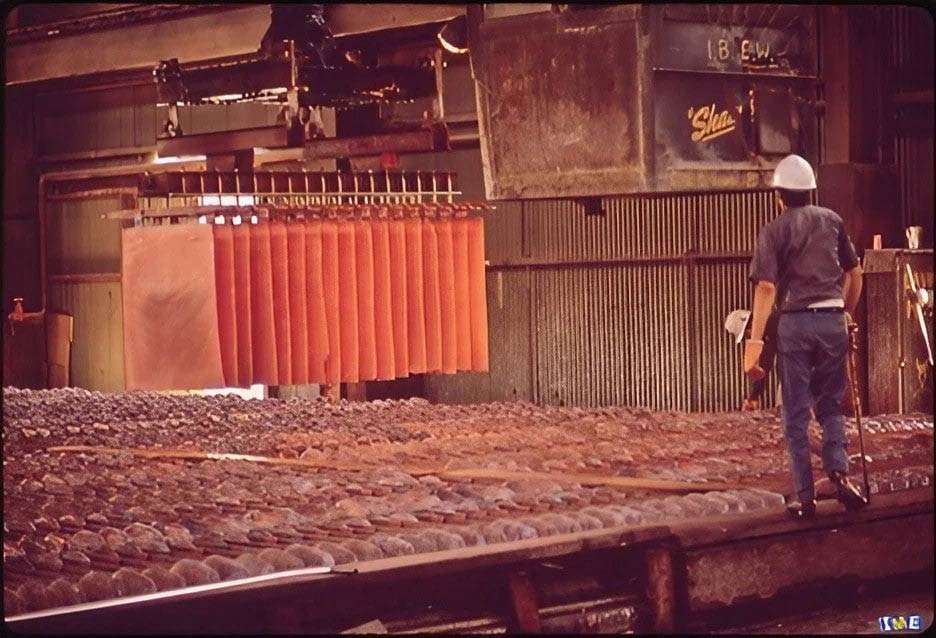
Cathode, billet and ingot programmes: pricing has retraced from January records but remains historically elevated.
Industrial minerals
Minerals remain the steadiest part of the book. Barite, bentonite, gypsum, aggregates and cement clinker are tracking regional construction and drilling activity rather than exchange sentiment, and demand indicators stay constructive: industry analyses put the construction aggregates market on a mid-single-digit growth track through 2026, with roughly 45% of clinker demand tied to infrastructure programmes. Availability through our quarry and partner network is reliable, with lab certification handled under our quality assurance function and shipment planning under Supply Chain & Logistics. Grades are listed on the Industrial Minerals page, part of our Mining, Minerals & Natural Stone sector.
Petrochemicals
Urea has turned decisively higher, moving up to roughly US$400 per tonne on 7 August — a gain of around 3% in a single session on Trading Economics data — as Gulf export availability tightened. Methanol is range-bound but with an unusually wide regional spread: US contract-linked levels around US$0.66–0.70 per kg against Chinese levels near US$0.32–0.35 per kg, an arbitrage that is itself a function of freight and war-risk cost rather than production economics. Sulphur, bitumen and base oil buyers should expect the same pattern: origin-differentiated pricing, with the delivered number driven by routing. Product detail is on our Petrochemicals & Chemicals page.
Plastics & polymers
Packaging polymers carry an upward bias. Prompt offers reported by trade services have HDPE injection near US$1,270 per tonne and HDPE blow near US$1,280 per tonne, with PP film around US$1,260 per tonne and Chinese PP futures ticking up to about CNY 8,135 per tonne on 10 August. ChemAnalyst notes HDPE remains far above pre-crisis levels and that renewed Hormuz disruption is tightening polyethylene and polypropylene supply, squeezing converter margins — BOPP spreads in particular have turned negative. PVC is the exception, with offers into South Asia easing. Converters running quarterly cover should consider bringing forward PE and PP requirements while leaving PVC on shorter cycles. Resin and film options are on our Plastics & Polymers page.
Freight: the swing factor
The Strait of Hormuz remains in de facto closure, with commercial transits reported at a small fraction of the pre-crisis daily average. Asia–Gulf container economics have moved accordingly: all-in quotations from South China to Jebel Ali have been reported in the US$8,250–9,500 per 40'HQ range, up sharply on July, and the war-risk, emergency-conflict, bunker and congestion surcharge stack can add several thousand dollars per box above the headline rate. Transpacific and Asia–North Europe lanes have firmed in sympathy, and air freight on India–Middle East routings has repriced dramatically as an emergency alternative.
The practical consequence: a soft FOB print no longer guarantees a soft landed cost. Any tender priced this month should be evaluated CFR or DAP, with the surcharge schedule and routing assumptions stated explicitly.
What this means for buyers
Three actions make sense on today's picture. First, use ferrous weakness to place forward cover on rebar, sections and semi-finished tonnage — but tender on a delivered basis so freight volatility sits with the party best able to manage it. Second, treat the copper retracement as an opportunity to layer in non-ferrous requirements rather than waiting for a bottom. Third, bring PE and PP cover forward while keeping PVC and minerals on normal cycles. Arian Holding's global sourcing desk can structure multi-origin supply that routes around the current chokepoints, with inspection and documentation handled by our quality assurance team. Request a quote and we will respond with firm, currently valid delivered pricing for your specifications.
Sources: Arab Iron and Steel Union and SteelRadar (rebar, iron ore, billet); Trading Economics (steel, urea, polypropylene); London Metal Exchange (copper, aluminium, zinc references); Plastic4trade and ChemAnalyst (polymers); Expert Market Research (methanol); Sea Vantage and Anadolu Agency (Hormuz, freight); Coherent Market Insights and Global Growth Insights (aggregates, clinker). Figures are indicative market levels around August 10, 2026, are directional and provided for general information only — not trading, investment or procurement advice. Firm pricing is available on request.