
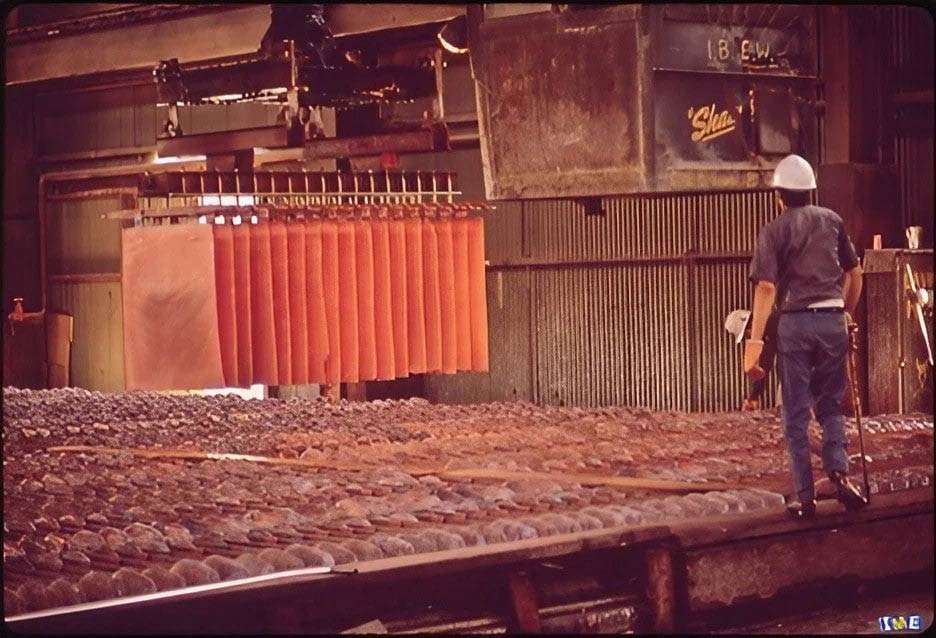
Copper cathode is the purest traded form of the world's most important electrical metal — the 99.99% sheet that is melted and cast into rod, wire, tube, busbar and brass. It sits at the centre of the energy transition: grids, electric vehicles, data-centre power and renewable generation all run on copper, and that demand is why the metal has traded near record levels through 2026. But "copper cathode" on a purchase order says little on its own. Purity route, brand registration, impurity profile and the physical premium all move the delivered cost and the suitability of the metal for your process. This guide walks through the grades, the specifications that decide performance, how brands and premiums work, and how to qualify a supplier. Browse grades on our Non-Ferrous Metals catalogue, part of our Industrial Products & Commodities sector.
The short version
Buy to a named standard — LME Grade A (ASTM B115 Grade 1 / EN 1978 Cu-CATH-1) at a minimum 99.99% copper — from a brand on the LME approved list, backed by a certificate of analysis that reads out the individual impurities, not just the headline purity. Confirm the production route (electrorefined vs SX-EW) if your end use is conductivity-sensitive, and price the physical premium separately from the LME screen, because premiums into Asia rose sharply through 2026 as import flows shifted toward African-origin cathode.
Step 1 — Start from the end use, not the metal
Cathode is a raw input to a conversion step, so the first question is what you are making. High-conductivity wire rod and oxygen-free applications are the most demanding on trace impurities and often prefer electrorefined material; brass mills, tube plants and general foundry work have more headroom. Define the downstream process — continuous cast rod, tube, busbar, brass alloying — and the conductivity or oxygen requirement before you talk grade. Everything else follows from that.
Step 2 — Know the grade standards
Copper cathode is governed by a small set of interchangeable international standards that all describe essentially the same high-purity product. The one your contract cites matters because it sets the acceptance and rejection limits, and because LME deliverability depends on it. Always confirm exact values against the producer's certificate.
| Standard / grade | Region | Minimum copper | Notes |
|---|---|---|---|
| LME Grade A | Global benchmark | 99.99% | Exchange-deliverable; requires a registered brand and one of the specs below |
| ASTM B115 Grade 1 | Americas | 99.99% (Cu-CATH-1 / C11040 basis) | Electrorefined or electrowon; suitable for wire rod |
| EN 1978 Cu-CATH-1 | Europe | 99.99% | European high-purity cathode standard |
| GB/T 467 Cu-CATH-1 | China | 99.99% | High-purity cathode; widely referenced in Asian trade |
Testing below roughly 99.97% copper is rejected against Grade A, so the gap between "99.9% commercial" and "99.99% Grade A" cathode is a real quality — and price — distinction, not a rounding difference. Our laboratory teams cross-check certificate values against the standard your contract names before release; see how in Quality Assurance.
Step 3 — Check the specifications that matter
Purity is necessary but not sufficient. Two cargoes can both read 99.99% copper yet behave differently in a wire-rod plant because of their trace-element and oxygen profiles. Match every property below to your application rather than buying on the headline number alone.
| Property | What it controls | Why it matters |
|---|---|---|
| Copper content (min 99.99%) | Base grade / deliverability | Sets Grade A acceptance; below ~99.97% is rejected |
| Trace impurities (Bi, Se, Te, As, Sb, Pb, S) | Conductivity & hot working | Even ppm levels degrade conductivity and cause cracking in rod |
| Total metallic impurities | Overall purity margin | Tough-pitch cathode typically holds under 50 ppm total |
| Oxygen content | Grade family | Tough-pitch carries some oxygen; oxygen-free needs <~10 ppm |
| Physical condition | Handling & melt losses | Sheets must resist breakage and be free of grease, dirt and loose nodules |
The trace elements do the damage: bismuth, selenium, tellurium, arsenic, antimony, lead and sulphur are the ones a conductivity-sensitive buyer reads first. Specify the full certificate of analysis element by element, and note that physical cleanliness — sheets free of copper sulphate, oil and dirt — directly affects your melt yield.
Step 4 — Understand brands and the LME approved list
Copper cathode trades on brand. Every LME-deliverable cathode is cast by a producer whose brand appears on the LME approved list, which is how the market guarantees consistent quality without re-assaying every cargo. Established producer brands carry that assurance and usually a firmer premium; unregistered or "equivalent-grade" (EQ) material can meet the chemistry but trades at a discount and is not exchange-deliverable. When you buy, confirm the specific brand and that it is on the current approved list — a traceable brand is the single best proxy for reliable quality, and it protects you if a cargo is ever disputed. This traceability is built into our global sourcing network.
Step 5 — Price the premium, not just the LME
The delivered cost of cathode is the LME price plus a physical premium that covers freight, financing, brand preference and local balance. The premium is quoted per tonne CIF into major hubs and moves on its own cycle. It matters a great deal right now: through 2026 registered Grade A premiums into Asia rose sharply, with long-term CIF Shanghai equivalent-grade offers pitched around US$80–110 per tonne — roughly US$80 above 2025 — as buyers competed for registered units and import flows shifted toward African-origin cathode, which by late 2026 accounted for close to half of China's imports. On the exchange itself, LME cash copper was around US$13,300 per tonne in early July, with 2026 forecasts spanning a wide range — Macquarie near US$13,165/t on average, Goldman Sachs in a US$10,000–11,000 band. Trade policy is another variable: the US declined to tariff copper cathode and high-grade scrap in mid-2026, but a proposed 15% cathode tariff is flagged for January 2027, which could redraw flows. The practical takeaway is to quote and compare on a delivered, premium-inclusive basis, and to qualify more than one origin.
Step 6 — Verify before you ship
- Specify the standard and grade by name — LME Grade A / ASTM B115 Grade 1 / Cu-CATH-1 — with the minimum copper content and any oxygen-free or conductivity requirement.
- Confirm the brand is on the LME approved list, and state whether equivalent-grade (non-registered) material is acceptable at a discount for your use.
- Request a recent certificate of analysis reading out copper content and the individual impurities against a named producer grade, plus the mill/works certificate tied to lot or bundle numbers.
- Agree the premium, Incoterm and loading dates in writing, and compare offers on a delivered, premium-inclusive basis rather than on the LME screen alone.
- Use independent pre-shipment inspection — weighing, sampling and assay at load port — for larger cargoes, and retain samples for dispute resolution.
Arian Holding builds these checks into every order through our global sourcing network and certified quality-assurance process, then manages bundling, containerisation and delivery via our Supply Chain & Logistics capability.
Frequently asked questions
What does LME Grade A copper cathode mean?
LME Grade A is the London Metal Exchange's deliverable copper standard: cathode of at least 99.99% copper, produced under one of the recognised specifications — ASTM B115 Grade 1, EN 1978 Cu-CATH-1, or GB/T 467 Cu-CATH-1 — and cast in a brand that appears on the LME's approved brand list. In practice it is the benchmark most international contracts reference, because it guarantees both the purity and the traceable producer brand. Cathode testing below roughly 99.97% copper is rejected. Specifying LME Grade A tells a supplier you expect exchange-deliverable quality rather than unbranded or off-spec material.
What is the difference between electrolytic (ER) and SX-EW copper cathode?
Both can meet Grade A purity but are made by different routes. Electrorefined (ER) cathode is produced by refining copper anodes from smelted concentrate, and generally carries the broadest acceptance including for oxygen-free and high-conductivity end uses. SX-EW (solvent extraction–electrowinning) cathode is produced hydrometallurgically from leached ore and is widely used and LME-deliverable, though some wire-rod and specialist buyers still prefer ER material for the most demanding conductivity applications. For most rod, tube and brass applications either route is suitable if it meets the chemical spec; confirm the route when your end use is sensitive.
Which impurities matter most in copper cathode?
For high-conductivity uses the critical trace elements are bismuth, selenium, tellurium, arsenic, antimony, lead and sulphur, because even parts-per-million levels degrade electrical conductivity and hot-working behaviour. Grade A specifications cap total impurities tightly — electrolytic tough-pitch copper typically carries under 50 ppm of metallic impurities — and set individual limits on the most damaging elements. Oxygen is controlled separately: tough-pitch cathode carries a little, while oxygen-free grades require it below about 10 ppm. Always read the certificate of analysis element by element against your application, not just the headline copper percentage.
What is a copper cathode premium and why does it change?
The premium is the amount paid over the LME cash price to secure physical metal at a delivery point, covering freight, financing, brand preference and local supply-demand balance. It is quoted per tonne on a CIF basis into major hubs and moves independently of the exchange price. Through 2026 premiums for registered Grade A cathode into Asia rose sharply — long-term CIF Shanghai equivalent-grade offers were pitched around US$80–110 per tonne, roughly US$80 higher than 2025 — as buyers competed for registered units and import flows shifted toward African-origin material. Watching the premium, not just the LME screen, is essential to landing an accurate delivered cost.
What documents should I request from a copper cathode supplier?
Request the producer's certificate of analysis stating copper content and individual impurity levels against a named grade (LME Grade A / ASTM B115 Grade 1 / Cu-CATH-1), confirmation that the brand appears on the LME approved brand list, and the mill test certificate or works certificate tied to specific lot or bundle numbers. For larger cargoes add independent pre-shipment inspection with weighing and sampling, and clear terms on premium, Incoterm and loading dates. Traceable brand plus a recent certificate of analysis is what separates exchange-quality cathode from unbranded or off-grade material.
Sourcing copper cathode with Arian Holding
Arian Holding supplies LME Grade A copper cathode from registered producer brands, backed by certificates of analysis, laboratory verification, multi-origin sourcing and resilient logistics across the GCC and beyond. Whether you need a single trial cargo or a forward programme, our trade desk can structure compliant, brand-matched supply, quote on a delivered premium-inclusive basis, and help you time entry through a volatile market. Copper sits alongside our aluminium and zinc lines and our wider steel and industrial minerals catalogue, so multi-material programmes can be consolidated under one desk. Request a quote with your target grade, brand preference, volume, Incoterm and destination and we will respond with current options.
Sources: ASTM B115 — Electrolytic Copper Cathode; LME — Special Contract Rules for Copper Grade A; Aurubis — Copper cathodes; Argus — US copper 2026 outlook; Goldman Sachs — copper price forecast 2026; SMM — 2026 copper long-term contract landscape; Trading Economics — copper. Specifications, grades and prices are indicative and provided for general information only; always confirm against the producer's current certificate and your own programme — this is not engineering or trading advice.