
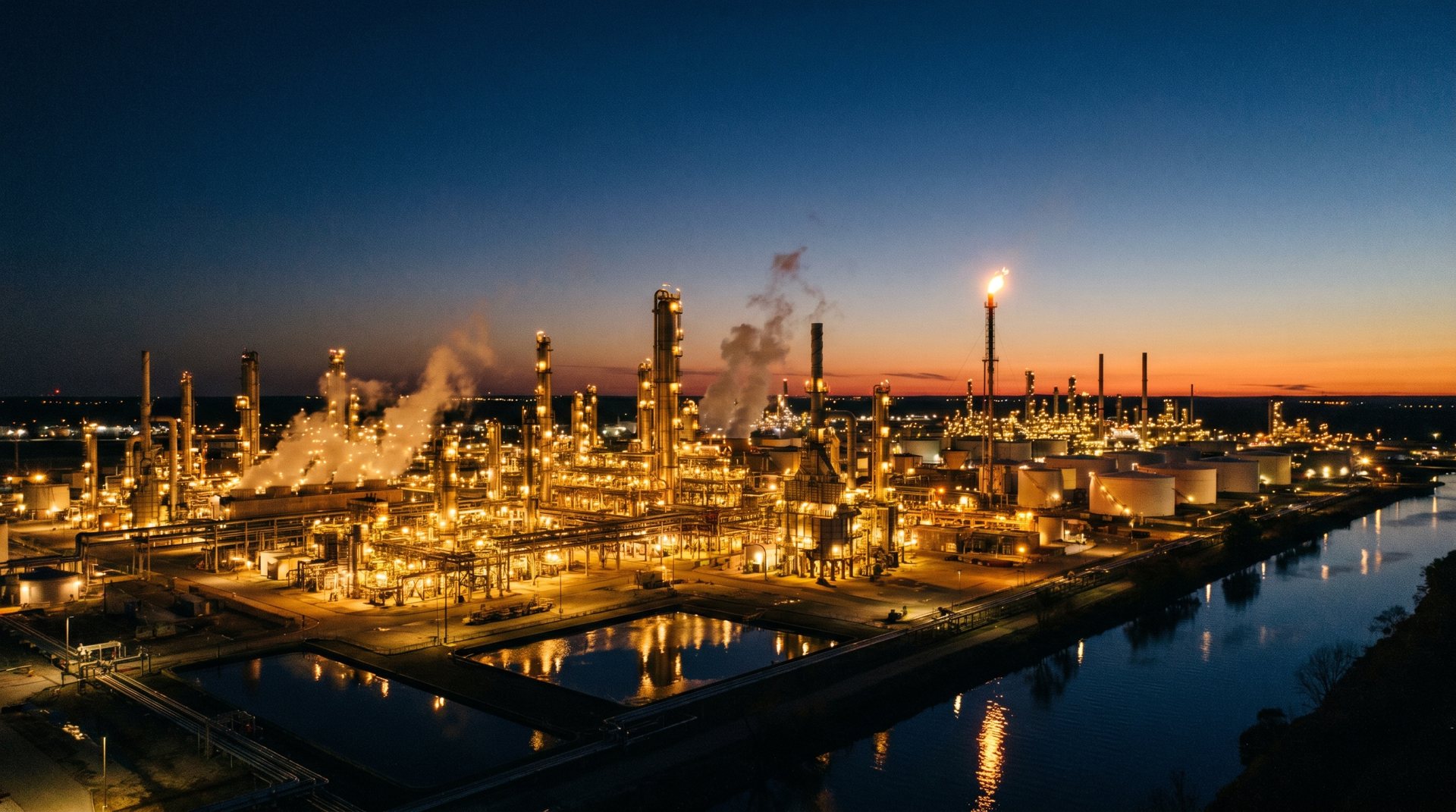
For most of this decade, the petrochemical story has been one of abundance. Wave after wave of new capacity — much of it in China and the US Gulf — pushed the industry into its deepest margin trough in years, and buyers of methanol, urea and polymers grew used to a market that worked in their favour. In 2026 that world met its opposite: an acute disruption at the Strait of Hormuz, the single most important artery for Middle Eastern chemical exports. The result is a market caught between structural glut and sudden scarcity — and buyers who read only one of those forces are exposed to the other.
The glut that defined the cycle
Start with the backdrop, because it has not gone away. Global overcapacity in basic chemicals has been building for years, and most forecasters — Wood Mackenzie and Deloitte among them — expect the petrochemical cycle to hit bottom in 2026 or 2027 before a gradual recovery toward the end of the decade. Ethylene margins for higher-cost producers spent much of the past year in negative territory, and Asian operators have been rationalising naphtha-fed steam-cracker capacity to survive it. Japan alone is on course to remove more than a quarter of its ethylene capacity, while Europe has seen a run of closure and divestment announcements.
The supply wave is not finished. New ethylene and polyethylene plants are scheduled to start up in 2026 in the United States and Qatar, where cheap feedstock gives producers a durable cost advantage. Golden Triangle Polymers — a Chevron Phillips Chemical and QatarEnergy venture — is expected to bring roughly 2 million tonnes a year of HDPE online in Orange, Texas by mid-year, almost entirely for export. In China, self-sufficiency policy keeps new polypropylene lines coming even as a prolonged property downturn saps domestic demand. On paper, that points to persistent oversupply and a buyer's market well into the year.
The shock that reversed it
Paper and reality parted ways in the spring. Disruption at the Strait of Hormuz — the chokepoint through which the bulk of the Gulf's petrochemical and fertiliser exports move — turned a comfortable surplus into a scramble for cargoes. The numbers behind the strait explain why the reaction was so violent: by UN Trade and Development estimates, roughly one-third of the world's seaborne fertiliser trade and a large share of global urea exports pass through it, and around 85% of Middle Eastern polyethylene exports route the same way.
When that flow is threatened, prices do not adjust gently. Granular urea jumped by about 50% in a matter of weeks, pushing past US$700 per tonne. Platts assessed CFR China methanol at a 54-month high near US$453/mt, with Southeast Asian spot reaching around US$690/mt CFR — its highest since 2013. Underneath it all, crude briefly touched roughly US$99 a barrel, dragging naphtha and propane feedstock costs up with it. The glut had not disappeared; it had simply been overwritten, for a time, by a supply shock the market could not price in advance.
Oversupply sets the floor and geopolitics sets the ceiling — and in 2026 the distance between them is where every sourcing decision is made.
Freight and insurance: the hidden second bill
The headline resin and fertiliser prices tell only part of the story. The cost of moving the molecules climbed just as sharply. War-risk insurance premiums for transits of the strait rose from around 0.125% to between 0.2% and 0.4% of a vessel's insured value — the equivalent of roughly a quarter of a million dollars in added cost for a single large tanker crossing. More than 150 tankers reportedly anchored rather than risk the passage, and major container lines paused transits, lengthening lead times and stranding cargo. For buyers, this is the reminder that a delivered price is never just the commodity: it is the commodity plus the route, the insurance and the certainty of arrival. That is why Arian treats supply chain and logistics as a core competency rather than an afterthought.
Reading the two forces together
The mistake in a market like this is to pick a single narrative. A buyer who anchors on the oversupply story alone will under-cover and be caught short by the next disruption; one who anchors only on the crisis will over-pay for cover that structural capacity may soon render unnecessary. The disciplined view holds both at once:
| Scenario | What drives it | Buyer posture |
|---|---|---|
| Base | Chokepoint risk eases; structural oversupply and new US/Qatar capacity reassert a soft, buyer-friendly market | Stay disciplined; cover near-term needs, avoid long forward commitments at elevated levels |
| Bull (for prices) | Renewed Gulf disruption keeps freight, insurance and feedstock elevated; supply of methanol, urea and sulphur stays tight | Secure forward cover and diversify origin away from single-route exposure |
| Bear (for prices) | Full normalisation of shipping into a still-oversupplied market; capacity additions land as planned | Buy need-to; let the glut work; keep inventory lean |
Across all three, the constant is optionality. The buyers who fared best in 2026 were not those who called the direction correctly, but those who could flex origin and routing as conditions changed — sourcing from cost-advantaged US and Qatari tonnage when Gulf flows were constrained, and leaning back on regional supply when they reopened. That flexibility rests on relationships across multiple producing regions and on the ability to move material by whatever lane is open, capabilities that sit at the heart of Arian's global sourcing network and its Industrial Products & Commodities desk.
What it means for buyers
For procurement teams buying polymers, petrochemicals and fertilisers, the practical lessons of this cycle are durable ones:
- Separate the structural from the situational. Distinguish the slow, capacity-driven glut from the fast, event-driven spike — and cover each on its own timeline rather than blending them into one nervous decision.
- Diversify origin, not just supplier. A portfolio that spans Gulf, US and Asian tonnage is more resilient than one concentrated on a single route, however cheap that route looks in calm conditions.
- Cost the whole delivery. Freight and war-risk insurance can move faster than the resin price itself; model landed cost, not just the quoted number, and value certainty of arrival alongside quality assurance.
Working with Arian Holding
Arian Holding sits precisely where these forces meet: a diversified trading and industrial group with the sourcing reach to access competitive petrochemical and polymer supply across producing regions, the logistics backbone to route around disruption, and the quality discipline to keep specifications intact as flows shift. In a market swinging between glut and chokepoint, that combination lets buyers plan through the volatility rather than react to it. To discuss grades, volumes, origin options and forward cover for methanol, urea, sulphur, bitumen, base oils and the full polymer range, request a quote and our petrochemical trade desk will respond with current options tailored to your operation.
Sources: Wood Mackenzie and Deloitte (oversupply, margin trough, recovery timeline); S&P Global (Asia cracker rationalisation, Japan capacity cuts); Argus (Golden Triangle Polymers HDPE start-up, new US/Qatar PE capacity); UNCTAD and World Economic Forum (fertiliser and PE share through Hormuz, insurance and tanker impacts); ChemAnalyst (methanol and urea price moves). Figures are indicative and drawn from the cited publications around mid-July 2026; this article is provided for general information and industry analysis, not as investment, trading or procurement advice.