
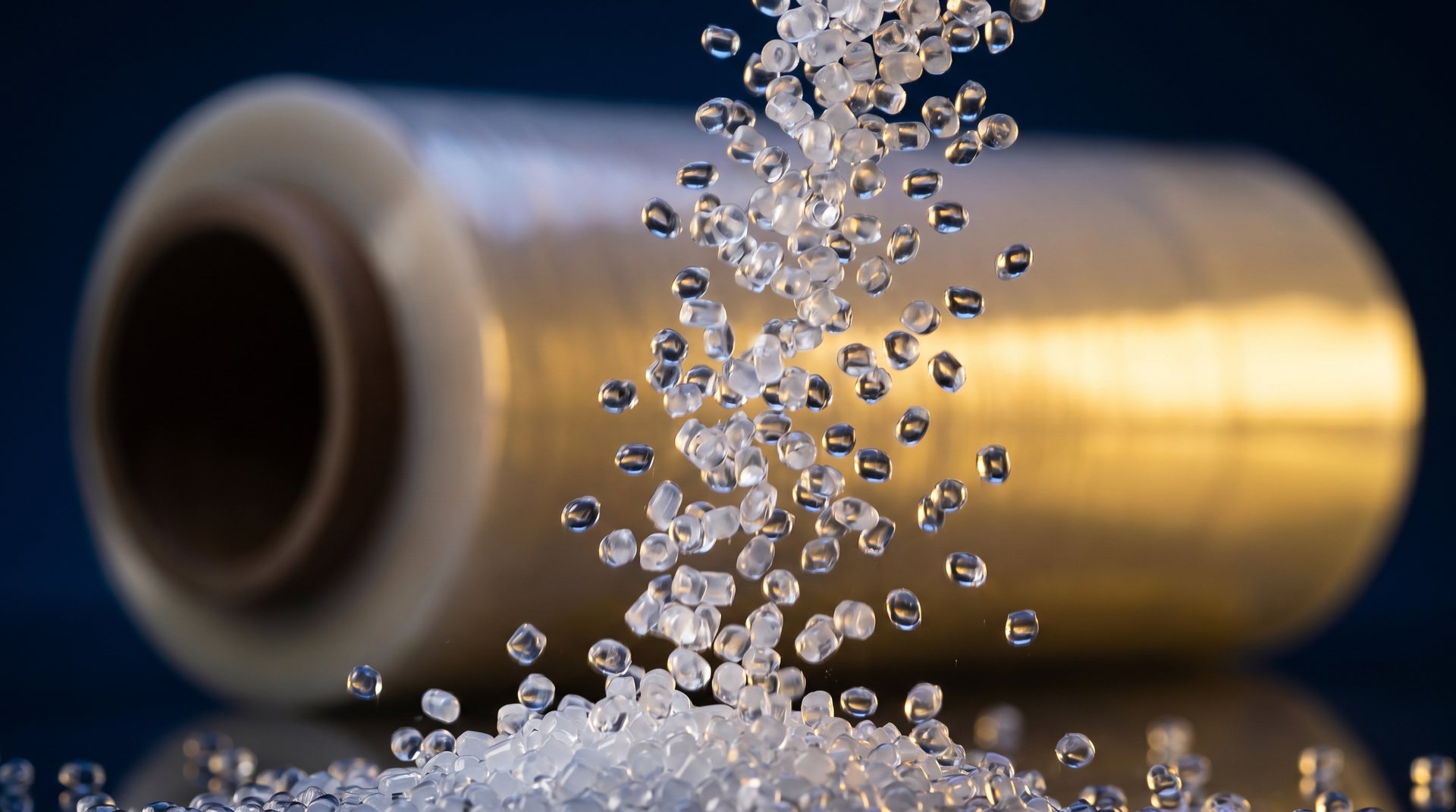
High-density polyethylene is one of the most widely traded thermoplastics in the world — the resin behind carrier bags and liners, milk and detergent bottles, jerry cans and drums, pressure pipe and dozens of moulded parts. It is a large and growing market: one industry estimate puts global HDPE at roughly US$62.7 billion in 2026, rising toward US$88.8 billion by 2033 at about a 5% annual rate. Yet "HDPE" on a purchase order means very little on its own. The same base polymer is tuned into dozens of grades, and buying the wrong one is an expensive mistake. This guide walks through how grades differ, which specifications decide performance, and how to qualify a supplier. Browse resin and film options on our Plastics & Polymers catalogue, part of our Industrial Products & Trading sector.
The short version
Choose your grade by process: low-MFI film and pipe grades for toughness, mid-MFI blow-molding grades for bottles and drums, high-MFI injection grades for caps and crates. Specify to a named grade with its MFI, density and — for containers and pipe — a minimum ESCR, insist on prime resin with a certificate of analysis, and lock in packaging and loading dates early, because new global capacity and freight swings are keeping polyethylene pricing volatile in 2026.
Step 1 — Start from the process, not the polymer
HDPE grades are engineered around the way the part is made. A film line, a blow-moulding machine, an injection press and a pipe extruder each demand a different melt behaviour, so the first question is never "what is the price of HDPE" but "what process and part am I feeding?" Define the conversion process, the wall thickness and the end use — food contact, chemical containment, potable water — before you talk grade. Everything downstream follows from that.
Step 2 — Understand the main grade families
Although producers list hundreds of grades, they cluster into a handful of families defined mainly by melt flow index and density. Film grades use very low flow so the melt can be drawn into thin, tough film. Blow-molding grades have high melt strength so the hollow parison does not sag. Injection grades flow freely to fill thin-walled moulds fast. Pipe grades such as PE80 and PE100 are qualified for decades of pressure service. The table below sets out the typical ranges — always confirm exact values against the producer's datasheet.
| Grade family | Typical MFI (g/10 min) | Typical density (g/cm³) | Common uses |
|---|---|---|---|
| Film / blown film | 0.04–0.1 | 0.945–0.955 | Carrier bags, liners, thin packaging film |
| Blow molding | 0.2–1.5 | 0.945–0.960 | Bottles, jerry cans, drums, fuel tanks |
| Injection molding | 4–20 | 0.950–0.965 | Caps, closures, crates, housewares |
| Pipe (PE80 / PE100) | 0.2–0.5 | 0.945–0.960 | Water & gas pressure pipe, fittings |
| Raffia / monofilament | 0.7–1.2 | 0.950–0.960 | Woven sacks, tapes, ropes |
A common pitfall is treating these as interchangeable because they are all "HDPE". Feed an injection grade into a blow-moulder and the parison collapses; feed a pipe grade into an injection press and the machine struggles to fill. Our laboratory teams cross-check certificate values against the grade you actually need before release; see how in Quality Assurance.
Step 3 — Check the specifications that matter
Whichever family you buy, a short list of properties decides how the resin runs and how the part performs. Match every one of them to your process and application rather than buying on headline price alone.
| Property | What it controls | Why it matters |
|---|---|---|
| Melt flow index (MFI) | Melt viscosity / flow | Sets processability; low MFI = tough film & pipe, high MFI = easy-fill moulding |
| Density | Stiffness & barrier | Higher density gives a harder, stiffer, more chemical-resistant part |
| ESCR | Stress-crack resistance | Critical for containers, tanks and pipe holding aggressive contents |
| Molecular weight distribution | Balance of flow vs strength | Broad distribution eases processing; affects toughness and creep |
| Additive package | UV, slip, antioxidant | Must match outdoor, food-contact or high-speed line requirements |
Two cargoes can share the same MFI and density yet behave very differently in ESCR or additive package — exactly the properties that cause a fuel tank to crack or an outdoor pipe to fail years later. Specify the full datasheet, not two numbers.
Step 4 — Verify before you ship
- Request the producer datasheet and a recent certificate of analysis covering MFI, density and, where relevant, ESCR — tied to a named grade, not a generic brochure.
- Confirm the grade family by name. State whether you need film, blow-molding, injection or pipe grade, and any PE80/PE100 or food-contact requirement.
- Insist on prime resin and traceability. Prime virgin product from a named producer varies only narrowly lot to lot; off-grade or reprocessed material can look identical but drift in flow and contamination.
- Match packaging to your site. Confirm whether you can discharge bulk, or need 25 kg bags or jumbo bags, and specify moisture-barrier liners where humidity is a risk.
- Use independent pre-shipment inspection at load port for larger contracts, and retain samples for dispute resolution.
Arian Holding builds these checks into every order through our global sourcing network and certified quality-assurance process, then manages bagging, containerisation and warehousing via our Supply Chain & Logistics capability.
Step 5 — Choose the right packaging
Packaging is a sourcing decision, not an afterthought — it dictates handling cost, contamination risk and how the resin is discharged. The main options are 25 kg polyethylene or paper bags (easy to distribute, higher unit cost), jumbo / FIBC bags of roughly 500 kg to 1.25 tonnes (efficient for mechanised handling), octabins for palletised bulk, and bulk in silo trucks or liner bags for large volumes (lowest unit cost, but needs silo or covered capacity at destination). Because pellets pick up moisture and dust, confirm liner quality against the humidity at your destination and fix the format on the contract.
Step 6 — Manage price and supply risk
HDPE has been a moving target through 2026. Trade-data providers reported an average around US$1,150–1,200 per tonne in the first quarter, with spot prices volatile amid Middle East shipping disruption and higher naphtha-linked feedstock premiums; in Saudi Arabia, a key export origin, the HDPE price index was reported up roughly 8% quarter-on-quarter early in the year. At the same time, a wave of new global capacity is expected to keep downward pressure on prices as fresh supply outpaces demand growth. The regional picture matters for buyers too: Asia-Pacific accounted for close to half of polyethylene demand in 2025, while the Middle East supplied more than 40% of global polyethylene exports, led by Saudi Arabia. The practical takeaways: qualify at least two origins, avoid buying into a policy- or freight-driven spike, and fix packaging and loading dates early. Polymers sit alongside our petrochemical and industrial minerals lines, so multi-material programmes can be consolidated under one trade desk.
Frequently asked questions
What do MFI and density tell me about HDPE?
Melt flow index (MFI, or melt flow rate) measures how easily the molten resin flows: a low MFI signals high molecular weight, high melt strength and toughness for film and pipe, while a high MFI flows freely and suits fast injection moulding of thin-walled parts. Density sets stiffness, barrier and heat resistance — HDPE typically falls between about 0.941 and 0.965 g/cm³, and higher density means a harder, stiffer part. Matching both numbers to your process and part design is the single most important step in choosing a grade.
What is the difference between film, blow-molding and pipe grades of HDPE?
They are the same polymer tuned to different molecular weights and flow. Film grades use very low MFI, roughly 0.04 to 0.1 g/10 min, so the melt can be drawn into thin, tough film without tearing. Blow-molding grades sit around 0.2 to 1.5 g/10 min with high melt strength so the parison does not sag, which suits bottles, jerry cans and drums. Pipe grades such as PE80 and PE100 use low MFI of about 0.2 to 0.5 g/10 min and are qualified for long-term hydrostatic strength and slow crack growth. Using the wrong grade for a process is the most common and costly sourcing mistake.
What is ESCR and why does it matter?
ESCR stands for environmental stress crack resistance — the ability of HDPE to resist cracking when it is under stress and in contact with detergents, oils or chemicals over time. It is critical for containers holding aggressive contents, for fuel tanks and for pipe, where a crack years later means product failure. Grades are formulated for high ESCR through molecular weight distribution and comonomer content, so for demanding containment applications you should specify a minimum ESCR value and confirm it on the datasheet, not just rely on MFI and density.
How is prime HDPE distinguished from recycled or off-grade material?
Prime resin is first-quality virgin product from a named producer, supplied against a technical datasheet with tightly controlled MFI, density and additive package that vary only narrowly from lot to lot. Off-grade, wide-spec or reprocessed material can look identical as pellets but drift in flow, colour, contamination and mechanical performance. Ask for the producer, grade name and a recent certificate of analysis, and for critical applications request lot traceability and a sample check, because the price gap between prime and off-grade often reflects real processing risk.
What documents should I request from an HDPE supplier?
Request the producer's technical datasheet plus a recent certificate of analysis stating MFI, density and, where relevant, ESCR and additive package against a named grade. For food, water or medical contact, ask for the relevant compliance statements. For larger contracts, independent pre-shipment inspection with retained samples and confirmation of loading dates is good practice given current freight and export-policy volatility across the main polyethylene export hubs.
Sourcing HDPE with Arian Holding
Arian Holding supplies prime HDPE across film, blow-molding, injection and pipe grades — in 25 kg bags, jumbo bags, octabins and bulk — backed by producer datasheets, laboratory certification, multi-origin sourcing and resilient logistics across the GCC and beyond. Whether you need a single trial cargo or a forward programme, our trade desk can structure compliant, grade-matched supply and help you time entry through a volatile market. Request a quote with your target grade family, MFI/density, volume, packaging and destination and we will respond with current options.
Sources: Coherent Market Insights — HDPE market size; Fortune Business Insights — Polyethylene market; ChemAnalyst — HDPE pricing; Expert Market Research — HDPE price trend; Sales Plastics — PE MFI & density guide; standard HDPE grade datasheets. Specifications, grades and prices are indicative and provided for general information only; always confirm against the producer's current datasheet and your own programme — this is not engineering or trading advice.