
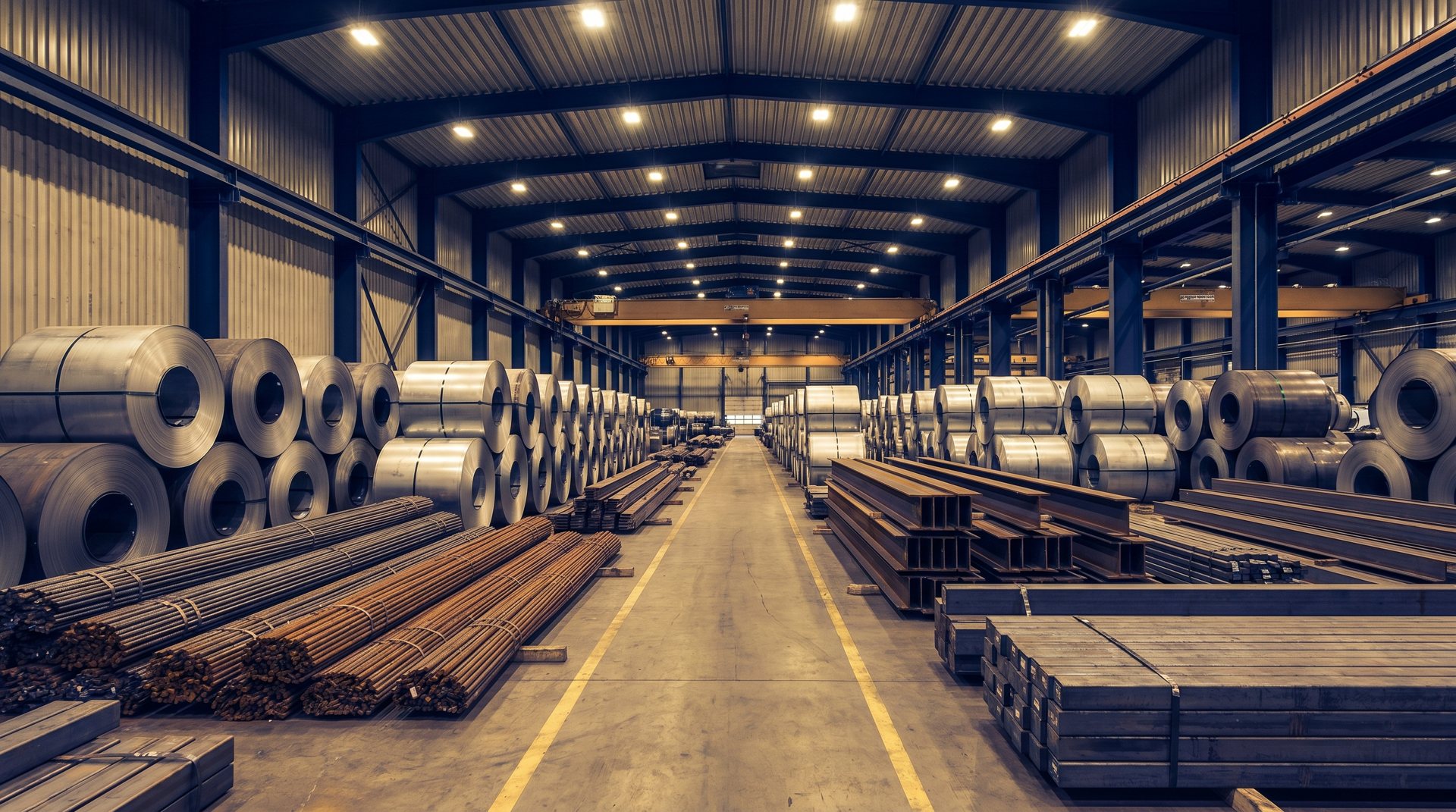
Welcome to Arian Holding's daily commodity briefing. Below is a concise read on where key industrial materials are heading as the week opens, with practical takeaways for buyers. A firmer freight market is the standout theme today — rising dry-bulk rates are quietly adding to landed costs even where underlying commodity prices are flat. For specifications, grades and quotations, each section links through to the relevant product catalogue page.
Today at a glance
| Commodity | Direction | Read | Catalogue |
|---|---|---|---|
| Iron ore & steel | Mixed | Ore recovering toward ~US$105/t after an early-July dip near US$93/t; Chinese rebar futures at a four-month low | Steel Products |
| Copper | Firm | LME three-month around ~US$13,350/t, holding historically high ground | Non-Ferrous |
| Aluminium & zinc | Steady | Aluminium ~US$3,090/t on the LME; zinc broadly rangebound | Non-Ferrous |
| Industrial minerals | Stable | Barite, gypsum & aggregates tracking regional infrastructure demand | Minerals |
| Petrochemicals | Firmer | Methanol contract levels elevated; bitumen supported by higher crude | Petrochemicals |
| Polymers (PE/PP/PVC) | Softer | Indian producers cut PP, HDPE and PVC list prices in early July | Polymers |
| Dry-bulk freight | Rising | Baltic Dry Index near ~2,700, a two-week high, led by capesizes | Logistics |
Steel & iron ore
Iron ore is clawing back after a volatile start to the month, recovering toward roughly US$105 per tonne after sliding to a year-to-date low near US$93/t around July 1, according to Trading Economics; over the past four weeks the benchmark is still up around 5%. Finished steel, however, remains under pressure: Chinese rebar futures have slipped below CNY 3,060/t to a four-month low as narrowing mill margins and seasonal demand weakness weigh, with Chinese mill profitability easing to about 51%. The net picture is mixed — supportive raw-material costs against soft downstream demand. For project buyers, this remains a constructive window to lock certified-grade tonnage on forward programmes. See current grades and standards on our Steel Products and Semi-Finished Steel pages, both part of our Industrial Products & Commodities sector.
Copper & non-ferrous
Non-ferrous metals remain the firmest corner of the complex. Copper is holding historically high ground, with the LME three-month around US$13,350/t on structural tightness and electrification demand. Aluminium is steadier near US$3,090/t on the LME, while zinc is broadly rangebound. Buyers of ingots, billets, cathodes and wire rod should continue to plan for elevated pricing and keep cover in place; explore specifications on our Non-Ferrous Metals catalogue.
Industrial minerals
Industrial minerals — barite, bentonite, gypsum, aggregates and cement clinker — are tracking stable, underpinned by infrastructure and construction activity across the GCC and wider region. Availability is reliable through our quarry and partner network, backed by lab certification and the logistics strength described in our Supply Chain & Logistics capability. Browse grades on the Industrial Minerals page, part of our Mining, Minerals & Natural Stone sector.
Petrochemicals
Petrochemical markets are firmer at the top of the chain. Methanex posted a European contract reference around €915/tonne for the third quarter, keeping methanol at elevated levels, while bitumen is supported by higher crude and tighter regional supply. Urea has been choppier, easing off earlier highs but still firm year-on-year. For contract buyers, the message is to secure cover on firmer grades rather than wait for a pullback. See available products — urea, sulphur, bitumen grades, base oils and methanol — on our Petrochemicals & Chemicals page, and note our quality-assurance processes for spec-critical volumes.
Plastics & polymers
Polymer list prices softened into early July. Indian producers reduced offers effective July 2 — PP down about Rs 12.5/kg, HDPE and LLDPE down roughly Rs 10/kg and PVC down around Rs 3/kg — while Chinese polyethylene, though up on the day near CNY 6,865/t, is still down sharply month-on-month. Converters have shifted to need-to buying to preserve working capital. Net: a buyer-friendly window to replenish selectively without chasing the market. View resin and film options on our Plastics & Polymers page.
Freight & logistics
Dry-bulk freight is the week's mover. The Baltic Dry Index has climbed for four straight sessions to near 2,700 points, its highest in two weeks, led by a ~4.6% jump in the capesize segment on stronger iron-ore shipments from Australia and Brazil. For buyers of ore, clinker, aggregates and other bulk cargoes, rising vessel rates feed straight into landed cost — a reminder to factor freight into forward budgets. Our Supply Chain & Logistics and global sourcing teams structure delivered-price offers that lock this in.
What this means for buyers
With ferrous mixed, copper firm, petrochemicals firmer and polymers softer, a selective, forward-cover approach is sensible as the week opens — replenishing polymers while list prices ease, keeping methanol and bitumen cover in place, and building rising freight into landed-cost planning. Arian Holding's global sourcing and quality-assurance teams can structure compliant, multi-grade supply across all of the above. Request a quote and our trade desk will respond with current, firm pricing for your specifications.
Sources: Trading Economics (iron ore, steel, Baltic Dry Index); London Metal Exchange; Methanex; SteelRadar; ChemOrbis; Polymerupdate; Reuters/Investing.com freight coverage. Figures are indicative market levels around July 6, 2026 and are provided for general information, not as trading advice.