
Steel is not one material but a family of thousands, separated by tiny differences in chemistry and processing. The codes stamped on a mill certificate — S355, A572, Grade 60, B500B — are shorthand for a defined recipe of strength, ductility and weldability. Read them correctly and you buy exactly the performance a project needs; read them loosely and you risk over-paying for unnecessary strength or, worse, under-specifying a safety-critical member. This explainer decodes the main grading systems Arian Holding trades across long and flat steel products, so procurement and engineering teams speak the same language.
The short version
A steel grade encodes minimum yield strength (the safe working limit), tensile strength (the breaking point) and ductility (how much it bends before it snaps). European grades use the letter S plus the yield in MPa (S235, S355); American grades use ASTM numbers (A36, A572); rebar uses Grade 60 or B500. The numbers are not interchangeable across standards — always specify the governing code.
Start with the three properties that matter
Almost every grade comes down to a trade-off between three measured properties. Yield strength is the stress at which steel begins to deform permanently; designers keep working loads below it, so it is usually the headline number in the grade name. Tensile strength is the maximum stress before fracture. The gap between the two, expressed through elongation, describes ductility — how much the steel stretches and absorbs energy before failing. High yield saves weight; high ductility saves lives in earthquakes and impacts. A good grade balances both for its intended use.
"The grade name is a promise about minimum performance — not a description of a single, fixed material."
European structural grades: the S-system (EN 10025)
In the European system the letter S means structural steel and the number is the minimum yield strength in megapascals for thin sections. So S235 yields at about 235 MPa, S275 at 275 MPa and S355 at 355 MPa. S235 and S355 are the workhorses: S235 for general fabrication and lightly loaded frames, S355 for main beams, bridges and crane girders where its extra strength lets engineers use lighter sections. One catch worth remembering: yield strength falls as thickness rises, so an S355 plate over 63 mm is only guaranteed to about 315 MPa. Hollow sections follow companion standards EN 10210 and EN 10219.
American structural grades: the ASTM system
North American practice names grades by ASTM specification rather than yield. ASTM A36 is the classic mild structural steel with a minimum yield around 250 MPa, broadly comparable to S235 but governed by different chemistry and testing. ASTM A572 Grade 50 — a high-strength low-alloy steel yielding around 345 MPa — is the practical counterpart to S355 and dominates American building and bridge steel. Cross-standard "equivalents" are useful for sourcing, but they are starting points only: tolerances, impact-test requirements and chemistry limits differ, so the governing code on the drawing always wins.
Reinforcing bar: Grade 60, B500B and TMT
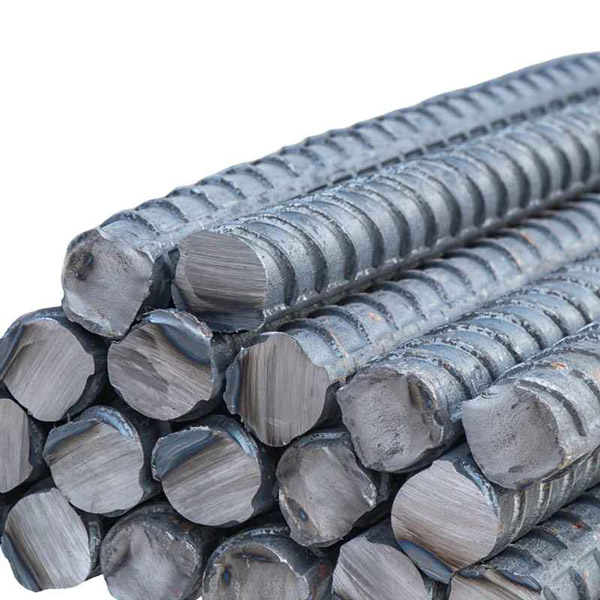
Concrete reinforcement uses its own grades. ASTM A615 Grade 60 — minimum yield of 60 ksi, about 420 MPa, with tensile near 90 ksi — remains the most widely specified rebar worldwide for its balance of strength, ductility and cost. European practice uses B500B and B500C: a 500 MPa minimum yield with ductility classes B (normal) and C (high) for seismic zones. Much modern rebar is produced as TMT (thermo-mechanically treated) bar, quenched at the surface and self-tempered to combine a hard skin with a ductile core, achieving elongation above 16–20% for earthquake-resistant design. These bars and semi-finished billets are core to our long-products desk.
Quick reference: common grades at a glance
The table below summarises the most-traded grades and their approximate minimum yield. Figures are indicative reference points for thin sections; confirm against the current standard edition and the project specification.
| Grade | Standard | Min. yield (approx.) | Typical use |
|---|---|---|---|
| S235 | EN 10025 | 235 MPa | General fabrication, light frames |
| S355 | EN 10025 | 355 MPa | Main beams, bridges, crane girders |
| ASTM A36 | ASTM | ~250 MPa | General mild structural steel |
| ASTM A572 Gr.50 | ASTM | ~345 MPa | High-strength buildings & bridges |
| Grade 60 | ASTM A615 | ~420 MPa | Concrete reinforcing bar |
| B500B / B500C | EN 10080 | 500 MPa | Rebar, incl. high-ductility seismic |
Where a project crosses standards, our laboratory teams reconcile certificates against the governing code before release; see how in Quality Assurance.
Beyond strength: weldability, coatings and corrosion
Two structures can call for the same yield yet very different steel. Weldability is governed by carbon equivalent, a single figure that rolls carbon and alloying elements into a prediction of how crack-prone the weld zone will be; lower values weld more easily with less preheat, which is why B500B and most S-grades are formulated to stay within practical limits. In aggressive environments, epoxy-coated and galvanised rebar resist chloride corrosion many times better than bare bar and are now specified across a large share of marine and bridge work, extending service life by decades. Matching grade, coating and section to the environment is exactly the sourcing judgement our global sourcing desk applies to every enquiry.
Frequently asked questions
What does the number in a steel grade like S355 mean?
In the European EN 10025 system the letter S means structural steel and the number is the minimum yield strength in megapascals for thin sections. So S235 yields at about 235 MPa, S275 at 275 MPa and S355 at 355 MPa. Yield strength falls as section thickness rises, so the headline figure applies to the thinnest products and reduces for heavier plate and sections.
What is the difference between yield strength and tensile strength?
Yield strength is the stress at which steel starts to deform permanently, so designers size members to stay below it. Tensile strength is the maximum stress before the steel fractures. The gap between the two, together with elongation, describes ductility — how much warning and energy absorption you get before failure, which matters most in seismic and impact-loaded structures.
Is ASTM A36 the same as S235?
They are broadly comparable mild structural steels but not identical. ASTM A36 has a minimum yield around 250 MPa and is specified to American practice, while S235 is an EN 10025 grade with a 235 MPa minimum and European chemistry and testing rules. Treat cross-standard equivalents as a starting point and always confirm against the governing code, because chemistry, tolerances and impact requirements differ.
What does Grade 60 rebar mean and how does it compare to B500B?
ASTM A615 Grade 60 reinforcing bar has a minimum yield strength of 60 ksi, roughly 420 MPa, and a minimum tensile strength near 90 ksi. European B500B and B500C bar carries a 500 MPa minimum yield with ductility classes B and C. The grades are broadly equivalent in role but are not interchangeable across codes because ductility, elongation and bend-test criteria differ.
Why does steel weldability depend on carbon equivalent?
Carbon equivalent combines carbon with alloying elements such as manganese, chromium and nickel into a single number that predicts how hard and crack-prone the heat-affected zone becomes during welding. A lower carbon equivalent generally means easier welding with less preheat. Weldable grades such as B500B and many S-series structural steels are formulated to keep this value within practical limits.
Specifying steel with Arian Holding
Arian Holding trades the full ladder of carbon steel — rebar and wire rod, sections and merchant bar, hot- and cold-rolled coil, plate and semi-finished billets and slabs — across recognised EN, ASTM and regional standards. Our trade desk helps buyers translate a drawing into a precise, certified order: grade, dimensions, coating and test documentation matched to the code on the job. Explore the range in our Steel Products catalogue and the wider Industrial Products sector, then request a quote with your grade and tonnage.
Sources: EN 10025 / EN 10080 structural and reinforcing-steel standards; ASTM A36, A572 and A615; Fractory — structural steels S235/S275/S355; AZoM — structural steel properties; CJM Steel — ASTM A615 Grade 60; Heaton — B500A/B/C reinforcement grades. Grade figures are indicative and provided for general information only; always confirm against the current standard edition and the project specification — this is not engineering or trading advice.